OET Speaking · Australia · Coming soon
Practise OET Speaking role-plays with a patient who talks back.
Read your task card, then run a timed five-minute role-play with an AI patient or relative who is anxious, reluctant or confused — just like the interlocutor. Get feedback on the criteria assessors actually use.


A patient, relative or carer, played by AI.
10 free minutes every month. No card needed.
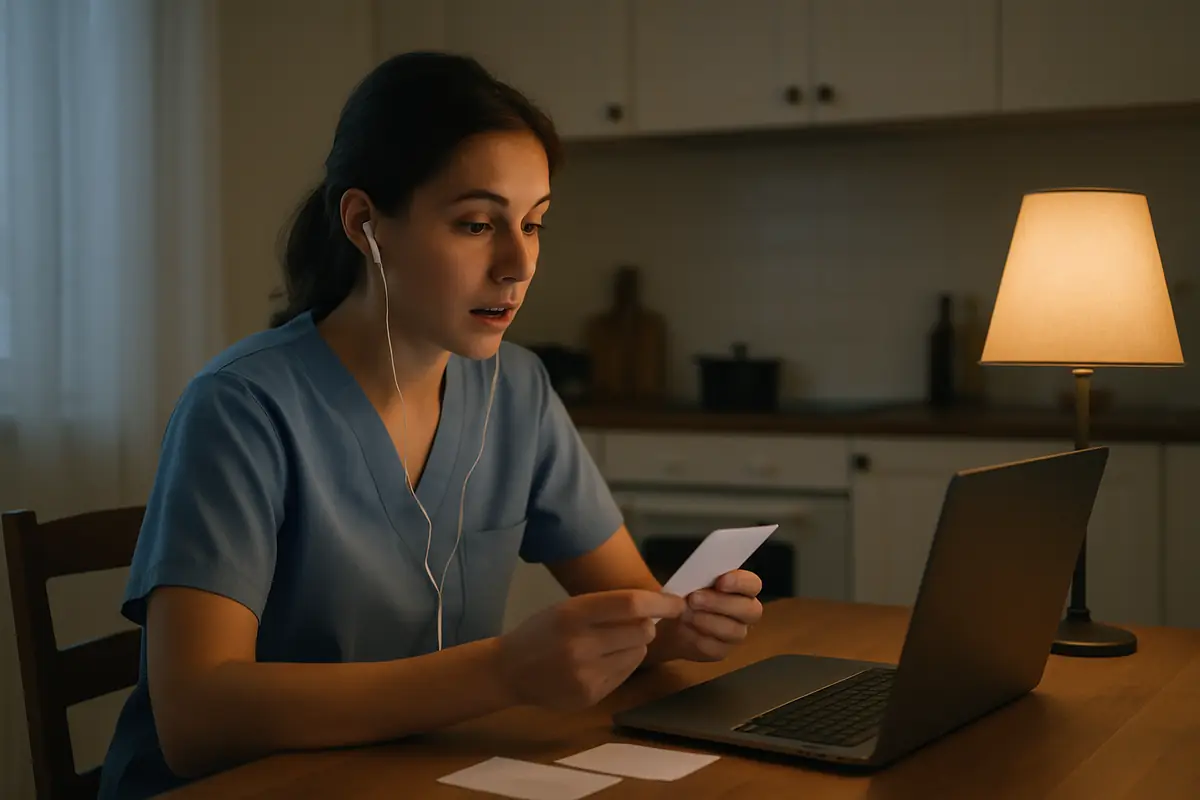
Example practice session: Mrs Chen says “I'm not getting out of this bed. What if my hip goes again?” You answer out loud and get feedback on Relationship & patient's perspective, Providing structure, Information gathering & giving.
The exam
The OET Speaking at a glance
Occupational English Test — Speaking sub-test, run by OET (Cambridge Boxhill Language Assessment).
Summary only — exam rules change. Always read the official candidate information before you book.
- 01Two role-playsEach about 5 minutes, after 3 minutes to read the card. You play your own profession; the interlocutor plays a patient, relative or carer.
- 02You leadThe candidate card sets the scene and lists 3–5 tasks. You normally open the conversation and keep it moving.
- 03Nine criteriaFour linguistic (intelligibility, fluency, appropriateness, grammar & expression) and five clinical communication criteria, converted to a 0–500 score.
- 04AHPRA requirementFor tests from 23 April 2026, AHPRA's Speaking minimum is 360. Check AHPRA's page for your circumstances.
- 05Recorded and marked laterTwo trained assessors mark the recording; the interlocutor doesn't mark you.

What XINGO helps you practise
- Five-minute timed role-plays with an original task card
- Openings, signposting, open-then-closed questions, plain-language explanations
- Handling anxious, angry or reluctant patients and relatives
- Feedback on relationship building, structure, information gathering & giving, language and fluency
Not covered (yet)
- Intelligibility and pronunciation (can't be judged from a transcript)
- Professions other than nursing and medicine (coming later)
- An official OET score — your score is an estimate from an AI examiner, not an official result.
Practice scenarios
Coming soon. These are the scenarios we're preparing.
- 01Post-op mobilisation (Nursing)A frightened patient refuses to get out of bed after hip surgery.
- 02Newly diagnosed diabetes (Nursing)An overwhelmed patient learning to check his glucose.
- 03Angry relative in ED (Nursing)De-escalate, gather history, explain triage.
- 04Warfarin discharge (Nursing)A sceptical patient who thinks warfarin is rat poison.
- 05Headaches — wants a scan (Medicine)Red flags, reassurance and saying no to a scan.
- 06Worsening pneumonia (Medicine)An honest update to a distressed son.


Tips from the marking criteria
- 1
Open like a professional
Introduce yourself, confirm the patient's name and the purpose of the conversation before diving into the tasks.
- 2
Ask, then explain
Find out what the patient already knows before explaining. Chunk information and check understanding.
- 3
Respond to emotion
Acknowledge worry or frustration specifically — formulaic phrases like 'I understand how you feel' can count against you.
How a session works
- Step 1
Read your task card
Each scenario starts with a card like the real exam's: the setting, who you are and what you need to do.
- Step 2
Speak with a realistic partner
The AI plays the patient, relative, colleague or examiner. Hold Space (or the mic button) while you talk. The session is timed like the exam.
- Step 3
Get exam-style feedback
An estimated score against the exam's own criteria, plus specific notes on what to fix next time.
Questions
Is this the official OET?+
No. XINGO is independent practice software with original role-play cards modelled on the public format.
Which professions are covered?+
Nursing and Medicine today. Tell us which profession you need next.
Can it score my pronunciation?+
Not reliably — feedback is based on what you said, so intelligibility isn't assessed. Everything else on the card is.
How long is each role-play?+
Five minutes, timed. Read your card first; it stays on screen during the role-play.
Guides
All guidesOET Speaking practice is coming soon.
NAATI CCL practice is open now. 10 free practice minutes every month. No card needed. Prices are in AUD.

Official sources
- OET — Speaking test information
- OET — Speaking criteria overview
- AHPRA — Accepted English language tests
XINGO is independent and not affiliated with OET (Cambridge Boxhill Language Assessment).